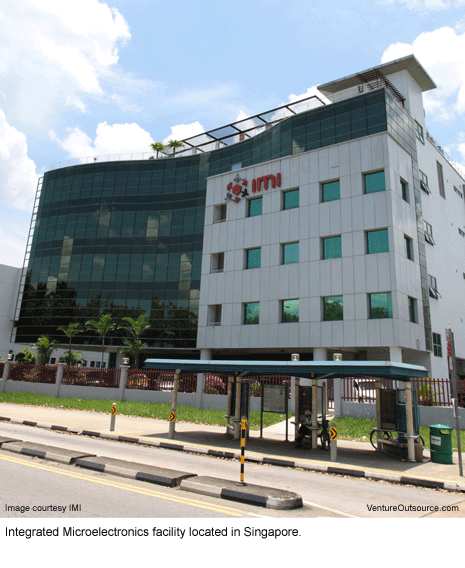
Integrated Microelectronics, Inc. (www.global-imi.com) is the electronics manufacturing services (EMS) arm of conglomerate Ayala Corp. (www.ayala-group.com). VentureOutsource.com speaks with IMI president and CEO Arthur R. Tan while traveling on business in Singapore.
Mr. Tan could be just the man to lead this Philippine-based $400 million, tier-3 EMS provider toward the Company’s goal of topping one billion dollars by 2011.
Tan took the helm at IMI in 2001. An engineer by training, Tan is a problem-solver capable of addressing challenges from both business and technical perspectives.
In 2005, the Company acquired the assets of US-based Saturn Electronics and Engineering Incorporated. That same year, IMI also merged with Speedy-Tech Electronics, Ltd., a Singapore-based EMS provider. The moves provided IMI with advanced manufacturing engineering and new product introduction centers in the US and manufacturing plants and design centers in Asia beyond the firm’s Philippine roots.

More acquisitions are in the works as Tan and his team is poised to continue transforming IMI’s operations into a global network of manufacturing and design services centers.
In this exclusive interview, Tan responds to questions about his reasoning behind IMI listing on the Philippine Stock Exchange by way of introduction (PSE: IMI.PH); challenges IMI faces competing against larger EMS providers, changes he’d still like to see internal IMI, OEM distrust of EMS providers, IMI acquisition strategy, and more.
Transcripts from that discussion follow.
VentureOutsource.com: Can you tell our readers what important leadership lessons you’ve learned?
Tan: I started my career in the Asia Pacific region, worked in the United States and then returned to Asia Pacific. So, the leadership criteria are pretty consistent except the execution sides are slightly different because of cultural differences.
One thing I work with every day, and this is something I also communicate to my staff, is that I never asked anyone to do something I wouldn’t do.
You also have to be consistent and you have to be transparent in how you deal with people and all stakeholders.
SEE ALSO
SE Asia contract manufacturing tips, strategy
Cost (pricing) models for EMS contract manufacturing
I also try to empower others as much as I can while making sure everyone understands accountability comes with that empowerment.
VentureOutsource.com: How has your leadership style changed over the years?
Tan: I’ve become a lot more open and sensitive to the personal side of interacting with the leadership team.
Methodology of an effective leader in western environments is different from being an effective leader in eastern environments. This melding of the two methodologies is something I’ve learned and adapted to – making myself – the management team at IMI, a very diverse management team.
Other companies have global footprints, but if you look at their core management team, they’re predominantly all western or all Asian.
My team is made up of a very, very diverse mix.

I have Germans; Americans, Malaysians, Singaporeans, Chinese, and some members from the Philippines in my direct staff that each have to work together culturally in order for me to manage and lead them.
VentureOutsource.com: What’s the basic message you have for all of your employees?
Tan: We must have a shared vision and share the same personal values that also align with our corporate values. Once this becomes fundamental to the organization, then everything else becomes so much easier.
The way we lead; the way we execute, the way we work, decisions we make down the line across different territories and geographies and levels have to emanate from these basic core values because if they do conflicts are greatly diminished.
In your search results, you will be able to further target provider options by choosing End Market, then selecting Go.
VentureOutsource.com: What unique capabilities does IMI have that might not be common to other EMS companies?
Tan: We’re an Asian-rooted EMS company but we are western in terms of our structure and the way we run our business.
The Asian side of the equation is represented by our current footprint, primarily here in Asia. It’s not like we’re a western EMS company, or a large EMS company that decided to expand into Asia.
We’re really an Asian EMS company just beginning to expand globally.

The reason we’re able to do this a lot easier than other Asian EMS providers is we have a very diverse management team that understands western methodology of engagement and how to operate in western environments.
I like the structure and the way the business is run on the western side but I also like the way the customer focus is on the Asian side.
Another component to our uniqueness is our business strategy follows two parallel tracks. One of these tracks is business. The other track is technology. IMI has a very strong technical ladder of capabilities.
To emphasize this, parallel to our business market strategy we continue to develop, we also make sure we have the technology so we are prepared as certain markets mature.
For example, we have an advanced manufacturing process group based in California which looks at next-generation manufacturing processes necessary for certain markets and products as they evolve toward those markets.
VentureOutsource.com: Which end-markets does IMI serve?
Tan: Computing; automotive, telecom, industrial and medical. But, part of our strategy involves submarkets within these markets.
In computing, we focus on storage technology. In automotive, we’re focused on safety and building systems and safety-related types of products. In telecom, we’re focused on infrastructure. In industrial, we’re focused on high-end security and industrial security systems. And, in medical, we’re focused on diagnostics and non-invasive medical products.
VentureOutsource.com: How is IMI revenue contribution distributed?
Tan: In the past, computing contributed the dominant percentage of revenues for the Company because of our affinity with the Japanese. We have a very, very large footprint with tier-1 Japanese customers. The Japanese customers we have in this space are good revenue generators for us. This customer space is geared toward the storage technology side of our business.
Today, telecom and computing, or storage technology, are actually about even contributors. Our fastest growing revenue contributors are in the automotive and industrial spaces.
VentureOutsource.com: Which end-markets are currently contributing the best margins?
Tan: Telecom, automotive, and industrial are each major margin contributors.
VentureOutsource.com: Let’s talk about IMI’s public trading status. The Philippine Stock Exchange recently suspended the implementation of rules on listing by way of introduction which, for our readers, allows a company to list its shares without immediately undertaking an initial public offering.
With regards to IMI just having completed its listing by way of introduction before this suspension took place, can you talk briefly about recent comments some financial analysts have shared regarding they feel the performance of IMI’s stock will be more tied to a global, broad-based economic recovery then to any particular performance (or factors of success) specific to IMI’s control. What are your thoughts on this?
Tan: I agree with them. If we look at the stock exchange for the Philippines and you look at the different companies represented in the exchange, there are a limited number of companies that reflect the global market versus reflecting just the domestic market.
There has been a substantial increase in the valuation of IMI within the stock exchange due to people – analysts and investors – discerning this is their window to what happens globally in spite of whatever the ramifications are of what is happening in the Philippines.
There are a number of compliant reasons why we opted for listing by introduction via the stock exchange.
First, when IMI started its business, the Philippines Board of Investments (www.boi.gov.ph) administered tax credits and other benefits to Philippine companies performing some amount of manufacturing internationally. Part of the requirements for these benefits also meant we had to become a public company.
The second reason is that throughout this period, as I had been becoming more involved with Integrated Microelectronics, I wanted to make sure each of our employees, or at least the majority of our employees, will be able to have some level of ownership of the Company so, I implemented an employee stock ownership program.
Meanwhile, the vesting period for the first wave of that program has already lapsed so I also wanted to provide a means of liquidity for those employees who already had vested shares in the Company.
We chose not to opt for an initial public offering because, at that point, IMI was still very financially stable. The projects we planned on doing…expansions we were thinking of, both organic or through mergers and acquisition – were still something that we could handle internally. So, there was no need for capitalization by way of a public offering.
In your search results, you will be able to further target provider options by choosing End Market, then selecting Go.
VentureOutsource.com: How does IMI see the EMS business environment changing in the tier-3 space it currently competes in compared to what the tier-3 EMS business environment was, say, before this recent downturn?
Tan: One of the things we’ve all noticed is that financial stability is a very critical element, especially for the EMS side of the supply chain. EMS companies dependent on the financial markets to grow or continue their businesses are very susceptible right now because available credit remains tight.
Even though we feel the economy is turning around, and we’re seeing an uptake in demand, not every EMS provider – especially those in my tier-level – is able to absorb this growth primarily due to financial market limitations.
IMI has remained relatively strong in this market because our net debt has been practically zero. We also have a very, very good cash position to help continue to drive our customer requirements.
VentureOutsource.com: Looking at EMS value propositions and ways EMS companies might differentiate themselves when competing for OEM programs, how do you see the EMS industry changing over the next three to fives years?
Tan: Collectively speaking, the entire outsourced electronics landscape is still a very small percentage of total electronics products produced, on an annualized basis, served by the EMS market. Saturation is roughly around 30 percent. This translates to about 70 percent of electronics products still being produced in-house by OEMs.
Meanwhile, the outsourcing market dictates the OEM model must partner more closely with EMS providers because OEMs are also being saddled by the same financial issues, plus the need to rationalize their asset base.
As OEM-EMS partnerships become closer, EMS companies will also transition into becoming more able to operate; develop and / or co-develop products, and manage different parts of the product life-cycle and realization for the OEM as we move forward.
EMS companies like IMI, with capabilities for co-developing a product and maintaining and warranting products post sale – will become more attractive to these OEMs as the market changes.
VentureOutsource.com: Correct me if I’m wrong, IMI has three wholly owned subsidiaries: IMI International, which is in Singapore, IMI USA, Inc., and IMI Japan. Is this accurate?
Tan: Yes, that is correct. IMI Singapore is actually our subsidiary that in-houses all of our China and Singapore subsidiaries. Whereas IMI USA houses our development and prototyping arm located in Tustin, CA as well as our new subsidiary in Fremont, CA for solar energy prototyping development.
VentureOutsource.com: Looking at the relationship(s) between these subsidiaries, do some of IMI’s OEM customers engage multiple IMI subsidiaries simultaneously?
Tan: Yes. We have a back-end process that seamlessly integrates developments performed at each of the different subsidiaries. A primary project lead can be located in Tustin, portions of product development can be performed either in the Philippines or in China – while it’s all consolidated in California.
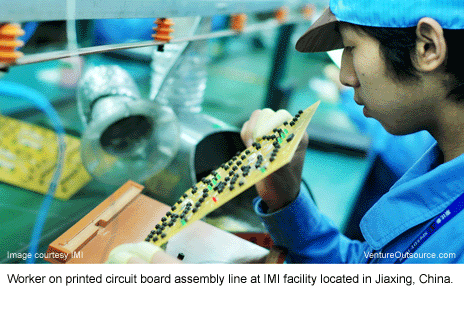
Once the product qualifies for manufacturing, production runs can either take place in China or the Philippines with California managing the transition to the facilities. This all takes place on the manufacturing process development side.
On the product development side, we have product development centers in the Philippines, in China, and in Japan. Once product development is complete we release the product to any one of our manufacturing sites.
VentureOutsource.com: As some readers may know, frequently, when organizations have multiple locations or there are different cost centers within the organization, a subsidiary or even a particular EMS location within the larger EMS organization can be reluctant to transfer an OEM program to a more suitable subsidiary (or alternate geographic location) within the same EMS company because the destination transferring the OEM program hasn’t yet been able to recoup its OEM program acquisition costs.
Essentially, financial metrics for the ‘originator’ are still in the red.
Even though the alternate subsidiary (or location) is more suited to the demand requirement of the OEM, EMS infighting can take place between subsidiaries / geographies because each EMS executive wants to recover his costs.
How does IMI handle these types of situations internally while also insuring OEM programs continue to run smoothly and bubbles don’t develop in customer supply chains?
Tan: IMI’s corporate structure takes the lead in these types of situations. The way we engage our customers and partners, we rarely do the analysis with them in terms of where technical resources are going to be tapped and where manufacturing will be most suited for them.
As you know, Mark, cost is not the only driver for making these decisions.
Customers may or may not want certain locations we might deem appropriate for their product. They may opt to have something performed elsewhere because of other, underlying strategic reasons.

We try and make sure there’s not much overlap with various manufacturing capabilities we offer. Certainly, the basic building blocks for electronics printed circuit board assembly are inherent at all of our sites.
There is also not much overlap of technical expertise for developing a specific product within our sites.
One area where we do have overlap for critical projects is risk-management which is enterprise-wide and takes place at the beginning of certain programs.
VentureOutsource.com: Looking at IMI Company finances and overall EMS company metrics, there are a few key metrics or financial indicators OEM executives and the financial community use to measure the financial health of EMS companies.
Some of these metrics include inventory turns; days sales outstanding, cash conversion cycle, debt-to-equity ratio, gross operating margin. Which of these can you speak to to provide our readers in the investment community a better financial snapshot of the Company?
Tan: Each of the metrics you mention are tracked internally and carries weight in how we make decisions as we move forward.
Of course, the level of sales revenue growth numbers versus net income numbers and so on carry different levels of weight depending on where we are at any given period.
Our focus at the end of 2008 was more on net income than revenue because we knew the revenue wasn’t going to be there but we had to manage our expenses and focus on our cash position to make sure we were viable moving forward. We were not interested in being leveraged by the financial community.
Right now, I’m happy to say near-term our debt position is very, very well-managed. Our net debt is practically zero.
We also continue to fund our capital expenditure requirements. We’re certainly not stopping capex. We try to make sure any invested capex or invested equity we have in the Company drives a fair amount of financial return.
We got hit in 2008 because of a one-time financial issue due to a reverse hedge we got caught in. But, we were able to recover completely from it in 12 months, in 2009 – which wasn’t even a great year.
In your search results, you will be able to further target provider options by choosing services, then selecting Go.
VentureOutsource.com: One of the more common ways to make a profit in EMS is to maximize material purchase-price-variance (PPV). Meanwhile, providing cost reductions to customers is something customers surely want, but sometimes customer demands are based on unrealistic expectations.
Plus, increases in EMS company profitability seem to always lead to new pressure from OEM customers for cost reductions from their EMS partners.
How can a company the size of IMI compete against companies like Flextronics, Celestica, Jabil Circuit or Sanmina-SCI if you’re not buying the same large quantity of materials from suppliers, thus enabling you to get more favorable PPV compared to the larger EMS providers with larger volume requirements and deeper pockets?
Tan: You’re right. That’s why we are more focused on the submarkets we serve rather than the general markets.
We try to stay away from highly commoditized end-markets which carry a lot of volume-type products. Our products are typically high-mix, low-volume. Our customer product volumes can still be in the millions annually, but their product types are such that the total product cost of ownership is something that is very important to our customers.
And, so we try to create a competitive market for our partners in terms of all of the different services and activities we can perform for them. Notwithstanding the material costs which are a large percentage of those costs.
We also work closely with the supply base we either inherit from the OEM or develop collectively plus we have a strong internal engineering group that helps us identify areas we can realize some of this cost competitive nature we are pressured to adhere to by OEMs. (For more on this topic, read: ‘Outsourcing cost reductions and benefits‘)
Get list of EMS manufacturers for your requirements (Its free)
Save time and money. Find quality EMS manufacturers. Fast. Venture Outsource has a massive, global database of contract electronic design and manufacturing capabilities. Speak with a Provider Advisor.
“Was able to very quickly find details on the important elements of setting up EMS and ODM partnerships, talked with an advisor for personalized info on quality providers matching our requirements while getting up to speed quickly about the industry and connect with key staff from like-minded companies and potential partners. Great resource.”
— Jeff Treuhaft, Sr. Vice President, Fusion-IO
Advisors tell you matches we find for your needs, answer your questions and, can share EMS industry knowledge specific to your industries and markets.