Contract electronics pricing and profits are topics on the minds of both the OEM executive as well as his counterpart, the electronics contract manufacturing executive. When it comes to OEM direct costs, these obviously weigh more heavily on the mind of the OEM.
Contract pricing and profits can determine which contract manufacturing companies (and their OEM customers) continue to gain market share and stay in business and which companies do not. (Read: How to drive costs out of your EMS manufacturing program)
Meanwhile, what determines contract pricing and profits for both parties derived from the outsourcing OEM’s direct costs of doing business with his outsourcing contract manufacturing partner.

While there are some common outsourcing manufacturing contract formats, no two contracts are identical and, there is no viable, common platform that can be applied to every outsourcing contract pricing model with regards to either party’s profits or, cost reductions.
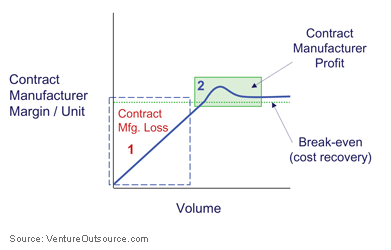
Meanwhile, the diagram below communicates how a high number of contract manufacturing executives run their businesses in hopes of being profitable.
The above is based primarily on the fact every request for quote (RFQ) process and contract negotiation process varies as does the list of dynamic objectives for management on both sides.
SEE ALSO
How to reduce costs from your manufacturing portfolio
Best practices for EMS manufacturing RFQ quotes
EMS Manufacturer internal cost vs OEM quoted fees vs OEM target price
Contract pricing, profits and negotiations
During contract manufacturing negotiations, it’s in the contract manufacturer’s best interest to try and drive (i.e., negotiate) contract pricing and profits with his OEM customer while focusing on the green-shaded area in the diagram (more on this in a moment)
Meanwhile, within the area of the diagram with the numerical value of 1, on the upward slope, is where the contract manufacturer is ramping the OEM’s outsourcing product program in production.
In this phase of the relationship, the contract manufacturer’s initial outsourcing contract profit per unit is low because of high fixed costs (i.e., non-recurring engineering (NRE) and extended non-recurring engineering (ENRE) costs), where:
NRE can include, but is not limited to:
- tooling, or
- special work stations
- conveyors, and other items
ENRE can include, but is not limited to:
- cost of starting a program
- pipelining materials
- seeding inventory and distribution channels, and
- managing component liability
However, as contract manufacturing production volume increases so does contractual profits per unit (this assumes the outsourcing provider has efficient operational and financial processes)
So that, once again, in section 2 (the green-shaded area), once the contract manufacturer covers the NREs and ENRE’s related to the outsourcing OEM’s product program need, the contract manufacturer’s transfer price (i.e., contract manufacturer’s ‘cost’ of manufacturing the OEM’s product vs. the ‘price’ at which the contract manufacturer sells the manufactured product to the OEM) drops off…leaving a smaller profit margin for the contract manufacturer above the contract manufacturer’s breakeven point.
In all instances, the contract manufacturer hopes, this price is above his breakeven point for cost-recovery.
Additional points of interest for OEMs
When negotiating contract pricing and contractual terms and while closely watching OEM direct costs, OEM executives will serve their organizations and investors best by establishing the following with their contract manufacturing executive counterparts whenever possible:
- encourage the contract manufacturer to invest in potential surge capacity should OEM product program volumes achieve unexpected velocity, and…
- create incentives for the contract manufacturer to manufacture and ship finished goods inventory ‘on-time’ and ‘on-schedule’ instead of determining the transition price (i.e., price the OEM pays for the contract manufacturer’s completed product) based solely on product quantities delivered by the contract manufacturer.
The latter is important. Otherwise, OEM executives can be faced with an issue where the contract manufacturer produces 100,000 units but, they are produced two months late which could lead to the OEM losing market share. Meanwhile, the contract manufacturer’s profit margins are not impacted as a result of the contract manufacturer’s own lack of performance.
In your search results, you can further target provider Services and Markets.
Get list of EMS manufacturers for your requirements (Its free)
Save time and money. Find quality EMS manufacturers. Fast. Venture Outsource has a massive, global database of contract electronic design and manufacturing capabilities. Speak with a Provider Advisor.
“Was able to very quickly find details on the important elements of setting up EMS and ODM partnerships, talked with an advisor for personalized info on quality providers matching our requirements while getting up to speed quickly about the industry and connect with key staff from like-minded companies and potential partners. Great resource.”
— Jeff Treuhaft, Sr. Vice President, Fusion-IO
Advisors tell you matches we find for your needs, answer your questions and, can share EMS industry knowledge specific to your industries and markets.