Reading tea leaves for top EMS providers
December 2007
A recent report by Deutsche Bank Equity Research analyst Sherri Scribner details some emerging themes in the electronics manufacturing services (EMS) market as investors and OEM company executives continue to try and differentiate supply chain outsourcing providers in the hyper-competitive EMS industry.
The report follows Deutsche Bank’s recent move as the investment bank resumes coverage of EMS providers Flextronics, Sanmina-SCI, Celestica and Jabil Circuit. The report also includes information on the electronics contract manufacturing industry leader Hon Hai. Some points of interest cited in the report follow and include:
- EMS restructurings
- Operations shifting to low-cost locations
- EMS vs. ODM business models
- Hon Hai market share driving EMS industry growth
- Financial metrics comparisons
Publisher’s note: ‘Deutsche Ban’, displays on some images. All image content provided by Deutsche Bank.
EMS restructurings
All four of the EMS companies Deutsche Bank is resuming coverage on are currently undergoing some type of restructuring.
Flextronics is in the middle of integrating the Solectron acquisition. The company expects to incur $430M to $500M in restructuring charges, and spend $500M to $550M in cash as part of its integration plan. Jabil is in the middle of a restructuring and rationalization plan that started in F4Q06. The company plans to incur roughly $250M of restructuring charges and spend $100M to $250M in cash to take high-cost manufacturing out of Western Europe.
Sanmina-SCI is also in the process of restructuring to return its business strategy to its original model which focused on the high-end market. Sanmina-SCI plans to sell its underperforming PC business, to focus on better cash conversion of its balance sheet, and to improve margins of its components businesses. The company took $45M in restructuring charges in FY07 and plans to take an additional $75M to $85M over the next six months for further plant closures and realignments.
Celestica is also currently restructuring its business, and has another $27M to take in restructuring charges before mid-2008 to turn around its Mexico and European operations, which are currently operating at a loss. The restructuring theme is not new, with many of these companies taking restructuring charges after the bursting of the tech bubble. Flextronics has taken restructuring charges each year since FY01 for some type of restructuring, spending nearly $3B during this period.
Jabil took restructuring charges of $165M in FY01 through FY03 to realign its business after the tech bubble burst. Sanmina-SCI has taken nearly $1B in restructuring charges since FY01 to improve its business model, while Celestica has taken over $2B in other charges to realign its business model. These charges suggest that the industry is plagued by chronic restructuring actions.
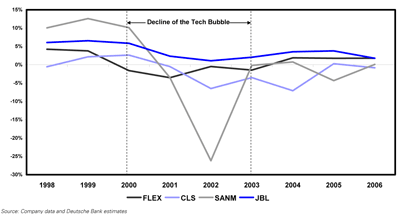
Figure 1: GAAP Operating Margins
Deutsche Bank believes the realignments are often necessary and important, the frequency of these changes suggests that they are an ongoing cost of doing business as an EMS firm. As a result, Deutsche Bank believes that generally accepted accounting principles (GAAP) operating income, as opposed to non-GAAP operating income, is more indicative of results over time.
As seen in Figure 1 above, Jabil has had the best operating margin results over the past eight years, with positive operating margins in all years, despite the bursting of the tech bubble. Flextronics was impacted by the bursting of the tech bubble, but has returned to positive GAAP operating margins over the past two years.
Celestica and Sanmina-SCI have been less successful, with negative operating margins in most years since 2001. Of the four companies, Sanmina-SCI has been hit the hardest, with operating margins falling from roughly 10% in the late 1990s to negative margins in the early 2000s.
While restructuring actions have clouded the profitability of the industry, Deutsche Bank believes current actions are necessary to increase capacity utilization. Many of the EMS companies today are operating at 50-60% utilization rates in their factories.
Deutsche Bank believes this is unsustainable, and that further industry consolidation or restructuring needs to take place to move these rates higher.
Operations shifting to low-cost locations
As part of the drive to reduce costs, EMS vendors have been shifting their manufacturing capacity from high-cost to low-cost locations. After the bursting of the tech bubble, many of the North American EMS companies realized that they had disadvantaged cost structures relative to their Asian-based EMS and ODM competitors due to the expensive manufacturing facilities they had built, or acquired, in the U.S. and Western Europe.
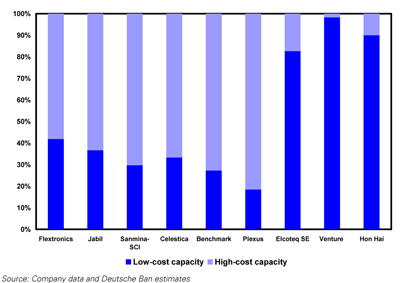
To better compete, EMS companies began to shift manufacturing to low-cost regions. Deutsche Bank estimates that since 2002, roughly 8.1 million square feet of manufacturing capacity in high-cost countries has been taken out by the top eight EMS companies seen in Figure 2 (excluding Hon Hai).
During this period, roughly 13.7 million square feet of manufacturing capacity has been added, with combined manufacturing capacity for these eight EMS companies now at roughly 65 million square feet. This suggests that about 21.8 million square feet of manufacturing has been added in low-cost locations.
Figure 2: Manufacturing Capacity Location by Cost, 2002
To better assess which companies have made the most progress realigning their cost structures since 2002, Deutsche Bank analyzed the manufacturing locations of the top EMS companies using per capita income to evaluate high versus low-cost locations, with countries with a per capita income of $20,000 or less falling under low-cost capacity and countries with greater than $20,000 falling in the high-cost category.
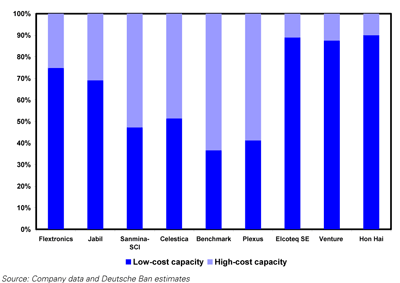
Figure 3: Manufacturing Capacity Location by Cost, Today
As seen in Figure 2 and Figure 3, all of the EMS companies have made progress in moving manufacturing facilities to low-cost countries. As seen in Figure 3, of the four companies being covered by Deutsche Bank, Flextronics has the highest percentage of low-cost manufacturing, with 75% of its manufacturing in low-cost countries.
Manufacturing area in low-cost countries for the other three companies are 69% for Jabil; 50% for Celestica; and 47% for Sanmina-SCI. This compares with the Asian-based EMS companies like Venture and Hon Hai, which have roughly 90% of their manufacturing in low-cost countries, particularly China and Malaysia.
For Hon Hai, Deutsche Bank estimates roughly 90% of its manufacturing capacity is in low-cost countries, particularly China, with the company currently planning a large move to Vietnam to further reduce costs.
While the Asian-based EMS companies appear better positioned based on manufacturing costs, the North-American EMS companies are better advantaged in the U.S. and Europe. Moving all manufacturing capacity to Asia works for some product segments, but does not work for some of the core EMS products like servers, storage, and telecom equipment.
For many of these more complex and specialized products, manufacturing needs to be done close to the end customer. As a result, many of the EMS companies have looked to low-cost countries near their end markets.
For the U.S. market, many of the EMS companies have located facilities in Mexico. For the Western European market, the EMS companies are building manufacturing capabilities in Eastern Europe and in the Soviet block countries. This allows EMS companies to reduce costs, while staying close to end customers.
ODM vs. EMS business models
Historically, ODM and EMS companies have had separate business models, with the ODMs primarily based in Taiwan and focused on the PC and mobile phone segments, while EMS companies were generally based in North America with a focus on the computing, telecom, and communications verticals. However, in an effort to take more share of the outsourcing opportunity, some of the EMS vendors have begun to adopt ODM strategies in some of their business segments.
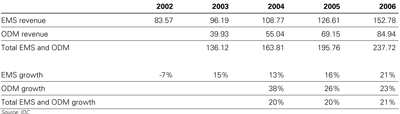
In addition to a larger slice of the outsourcing pie, many of the ODM segments have seen good growth in recent years due to their end-market exposure. As seen in Figure 4, ODM revenue growth has been in the mid-20s in the past two years, while EMS revenue has grown in the mid-teens to low 20s.
Deutsche Bank believes the faster growth of the ODM market is primarily due to these companies’ exposure to high-growth segments like the consumer, mobile phone and notebook markets. The ODM market model is in contrast to the EMS industry model, which has traditionally been focused on slower growth markets like servers, storage, telecom and communications.
Figure 4: EMS vs. ODM Growth
While the ODM industry is experiencing higher growth rates, Deutsche Bank believes an ODM model is appropriate for all markets or segments and believes the ODM model has been the most successful for high-volume markets like PCs and cell phones, which are relatively commoditized.
However, in highly customized applications like servers, storage, networking and telecom, the firm believes the OEMs prefer to use their own research and development (R&D) to develop unique products that are then manufactured by EMS providers. Examples of failed attempts include both Sanmina-SCI’s and Celestica’s attempts to bring an ODM model to the server market.
Flextronics is the only EMS manufacturer being covered by Deutsche Bank that has adopted an ODM model in some segments. Flextronics has had success with the use of this model for its mobile phone business, and has announced plans to aggressively enter the notebook market in 2008 with its acquisition of Arima.
Jabil has maintained a more traditional EMS approach, offering a joint design model (JDM) to its OEM customers in the mobile phone and LCD TV business.
Over time, Deutsche Bank expects each of the EMS providers to develop their own strategy in terms of ODM versus EMS, with the success of the mix of business dependent primarily on execution. In addition, the firm believes a hybrid model can work well for many of the EMS vendors, depending on the product design services and other product sets they offer.
Hon Hai takes market share, drives EMS industry growth
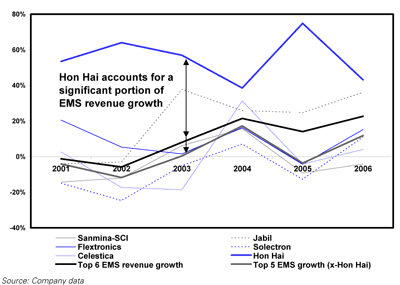
The 1990s were characterized by rapid revenue growth for EMS vendors, as the major OEMs shifted to outsource a significant portion of their manufacturing. From 1995 to 2000, EMS revenue* grew at a compound annual growth rate (CAGR) of nearly 60%. However, with the bursting of the tech bubble, revenue declined 1% and 6% in 2001 and 2002, respectively. However, this decline in EMS industry revenue was significantly offset by the growth experienced by Hon Hai.
Figure 5: Revenue Growth for Top 6 EMS Providers
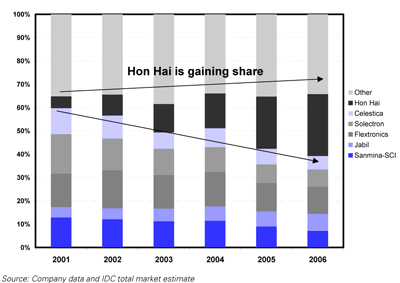
As seen in Figure 5, Hon Hai’s revenue growth has been significant, ranging from 40% to 75% from 2001 to 2006. Without Hon Hai’s growth, the EMS industry has only had positive revenue growth in two years since 2000. Hon Hai’s growth has led to considerable market share gains for the company. As seen in Figure 6, below, the only other top seven EMS vendor to grow revenue share during this period is Jabil, with Flextronics roughly maintaining revenue share, while Sanmina-SCI, Celestica, and Solectron have each lost revenue share.
* As measured by the top seven vendors (1995 to 2000): Celestica, Flextronics, Hon Hai, Jabil, Sanmina, Solectron, and SCI Systems.
Figure 6: Market Share for EMS Industry
Financial metrics comparisons
Return metrics
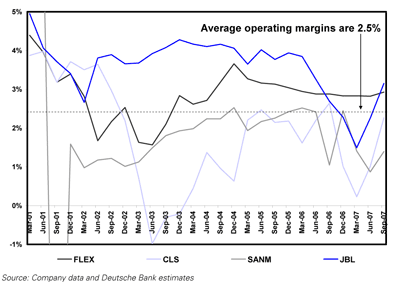
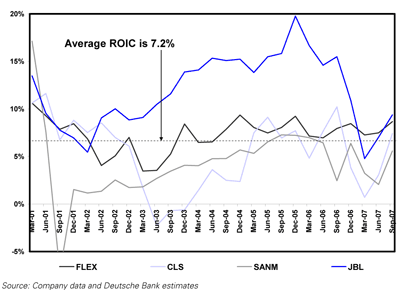
Deutsche Bank’s Scribner believes two important return metrics for the EMS industry are operating margins and return on invested capital (ROIC). As seen in Figure 7 and Figure 8, both non-GAAP operating margins and ROIC for the industry have jumped around since the beginning of 2000.
Figure 7: Non-GAAP Operating Margins
However, on both an operating margin and ROIC (return on invested capital) basis, Jabil and Flextronics have outperformed both Sanmina-SCI and Celestica. Jabil has delivered the best returns since C1Q01, with average operating margins of 3.6%, while ROIC has averaged 11.8%.
This is compared to the combined average for Celestica, Flextronics, Jabil and Sanmina-SCI of 2.5% operating margins and 7.2% ROIC. Flextronics has had the second-best returns during this period, with average non-GAAP operating margins of 2.9% and ROIC of 7.3%. During this period, Sanmina-SCI has under-performed its peers, with an average non-GAAP operating margin of 1.8% and an ROIC of 4.3%.
Figure 8: Return on Invested Capital (ROIC)
Of the four EMS companies, most have indicated plans to return to operating margins in the 3% to 4% range, above current levels. Jabil has a long-term target of 4% operating margins, which would be the highest in the industry. Celestica has commented that its long-term goal is 3% to 3.5%, and Flextronics believes it can get to an operating margin of 3.8% in FY09 after integrating Solectron.
Deutsche Bank believes ROIC is another important metric for measuring the EMS industry. As seen in Figure 8, ROIC has generally averaged below 10% since C1Q01. This compares to a weighted average cost of capital (WACC) range of 10% to 15% for the EMS companies.
Deutsche Bank believes it is important for the industry to deliver ROIC above WACC in order to create sustainable value for investors.
Balance sheet metrics
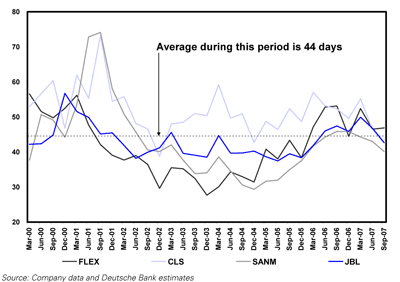
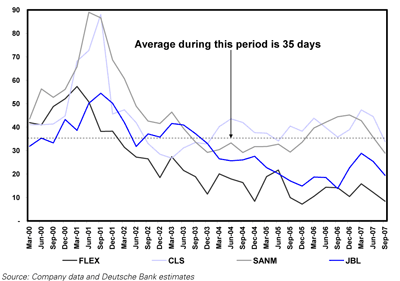
Cash generation is another important measurement for the EMS industry. As a result, the ability to manage balance sheet metrics, like inventory, and to have low cash conversion cycles (CCC) is important for the success of EMS companies. As seen in Figure 9 and Figure 10, inventory days and CCC have averaged 44 days and 35 days, respectively, since C1Q01.
Figure 9: Inventory Days on Hand
Flextronics has been the most successful at managing its balance sheet, with average inventory days of 40 days and CCC of 21 days. Celestica has had the most difficulty managing its balance sheet metrics, with average inventory days of 51 days and CCC of 44 days since C1Q01. However, as seen in Figure 9 and Figure 10, both Sanmina-SCI and Celestica have put significant emphasis on bringing these metrics down over the past few quarters.
Figure 10: Cash Conversion Cycle (CCC)
Revenue metrics
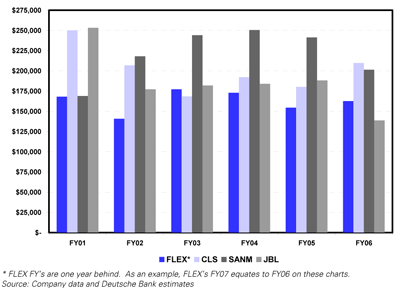
In order to assess the revenue generation of the EMS companies, Deutsche Bank also looked at revenue per employee and revenue per square footage. As seen in Figure 11, Sanmina-SCI has had the highest revenue per employee in recent years, with Celestica slightly beating Sanmina-SCI in FY06.
Figure 11: Revenue per Employee
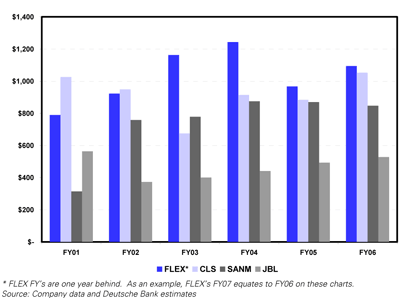
On a square footage basis (Figure 12), Flextronics has delivered the highest revenue per manufacturing area, suggesting a more efficient manufacturing footprint. At the other extreme, Sanmina-SCI has delivered the lowest levels of revenue per square footage, although the company has made consistent improvements in this metric since FY01.
Figure 12: Revenue per Square Footage
Source: Deutsche Bank Equity Research, VentureOutsource.com December 2007
VentureOutsource.com content is copyright protected and may not be rewritten, republished, or copied without permission.